

Table of contents
- The one-sentence answer
- How text-to-speech performance is measured
- What the benchmarks say about Kokoro-82M
- What the benchmarks say about Supertonic 3
- The head-to-head that explains our decision
- Why Local TTS connects the two models
- How to read these numbers honestly
- Frequently asked questions
- Hear the benchmarks for yourself
Local TTS ships with two neural speech models instead of one. Kokoro-82M reads its American and British English voices, and Supertonic 3 reads its 31-language multilingual voice. Both run entirely on your iPhone or iPad.
Why carry two models when one would make the app smaller and simpler? Because the published benchmarks give a clear answer: no single compact on-device model currently wins naturalness, reading accuracy, speed, and language coverage at the same time. Each of these two wins a different race, and pairing them lets Local TTS use each model exactly where it is strongest.
This article walks through the official evaluation results behind that decision—what the model publishers measured, what independent testing found, and how it translates into the reader you actually hear.
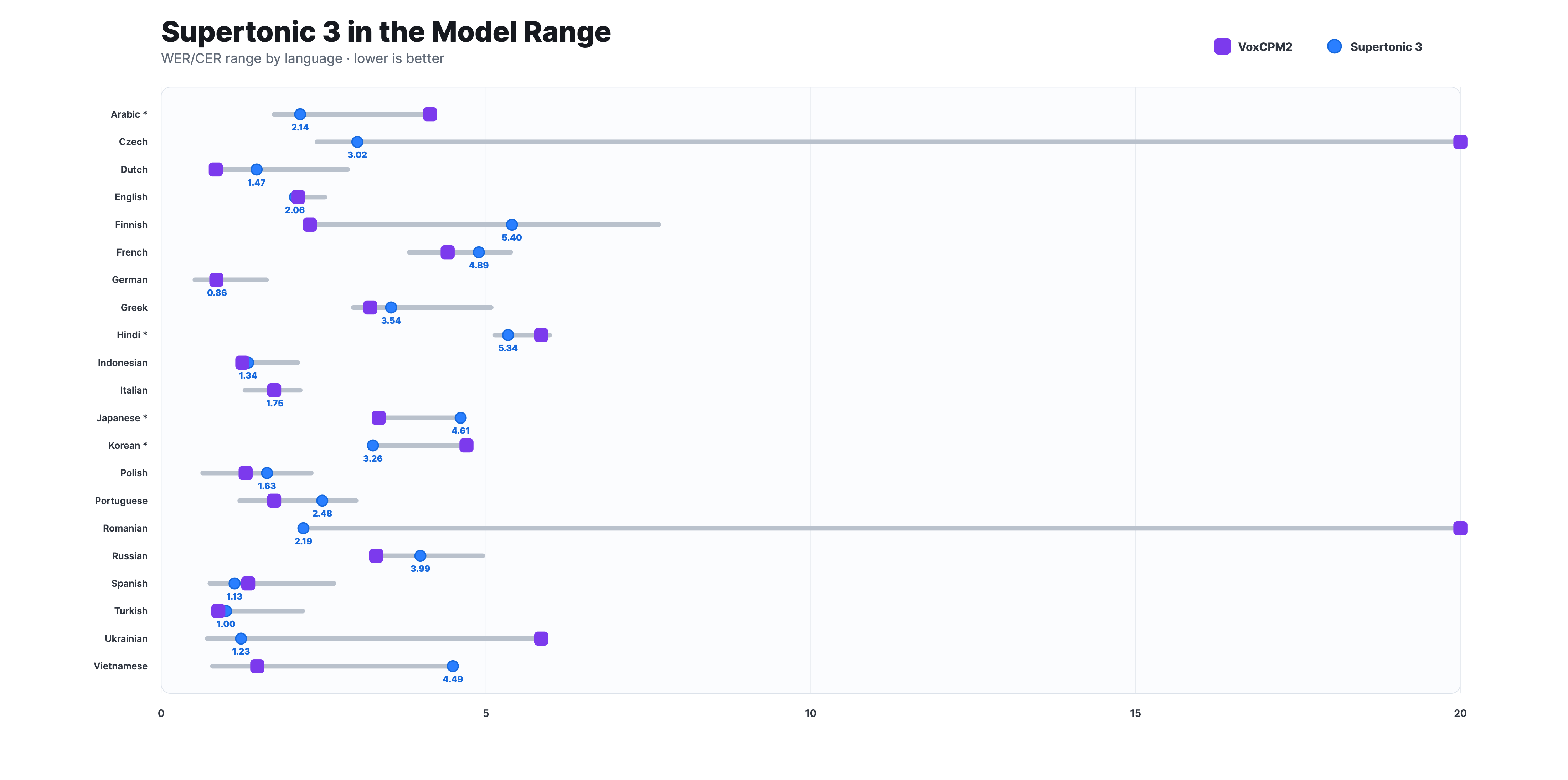
Sources and cover image: The cover is Supertone’s unchanged official reading-accuracy chart from the Supertonic repository. Kokoro figures are cited to the official hexgrad/Kokoro-82M model card; Supertonic figures to Supertone’s official repository and model card; the head-to-head CPU test to an independent third-party benchmark. Upstream numbers were measured by their publishers on their hardware, not on an iPhone.
The one-sentence answer
Kokoro-82M leads human naturalness ratings for English, Supertonic 3 leads on-CPU speed and reads 31 languages with competitive accuracy—so Local TTS routes English to Kokoro and everything multilingual to Supertonic 3, all on your device.
How text-to-speech performance is measured
Four measurements matter for a reading app, and it helps to know what each one means before looking at the numbers:
- Naturalness is judged by people. The best-known public test is a blind arena: listeners hear two anonymous clips and vote for the more natural one, producing an Elo-style ranking that marketing cannot influence.
- Reading accuracy asks whether the model spoke the text it was given—no skipped, repeated, or garbled words. It is scored as word error rate (WER) or character error rate (CER) by transcribing the generated audio back to text. Lower is better.
- Speed is reported as the real-time factor (RTF): synthesis time divided by audio duration. An RTF of 0.3 means one second of speech takes 0.3 seconds to generate—about 3.3× faster than real time. Lower is faster.
- Footprint covers parameters, download size, and memory—the difference between a model that fits in a phone app and one that needs a server GPU.
A cloud voice can chase all four with data-center hardware. An on-device model has to make trade-offs, and that is where the two models diverge.
What the benchmarks say about Kokoro-82M
Kokoro-82M’s headline result is a human-preference ranking. Before its v1.0 release, the official model card reported that Kokoro v0.19 ranked #1 in TTS Spaces Arena, the blind listening arena on Hugging Face—achieving a higher Elo than models many times its size, including XTTS v2 (467 million parameters) and MetaVoice (1.2 billion parameters), while training on just a few hundred hours of audio.
That is an unusual result worth pausing on. In a test where listeners could not see model names or parameter counts, an 82-million-parameter model was preferred over billion-parameter systems. For English naturalness per unit of compute, Kokoro set the standard for compact models.
| Kokoro-82M v1.0 | |
|---|---|
| Parameters | 82 million |
| Human evaluation | v0.19 ranked #1 in TTS Spaces Arena |
| Output | 24 kHz speech |
| Voices | 54 public voices; 28 English voices in Local TTS |
| License | Apache 2.0 |
| Role in Local TTS | American and British English catalog |
The trade-off is coverage. Kokoro’s public release spans eight languages, but its own voice catalog notes that quality outside English varies with training data. It is a specialist: exceptional English, thin elsewhere.
What the benchmarks say about Supertonic 3
Supertonic 3, released by Supertone on April 29, 2026, is evaluated in the opposite direction: breadth and efficiency. The official repository publishes reading-accuracy results on the Minimax-MLS-test benchmark, comparing its roughly 99-million-parameter model against much larger open TTS systems such as VoxCPM2, OmniVoice, and Qwen3-TTS.
Here are Supertone’s published error rates for the eleven languages this website is written in (lower is better; * marks character error rate, others word error rate):
| Language | VoxCPM2 | OmniVoice | Qwen3-TTS | Supertonic 3 |
|---|---|---|---|---|
| English | 2.11 | 2.02 | 2.25 | 2.06 |
| Korean* | 4.70 | 3.22 | 4.07 | 3.26 |
| Japanese* | 3.35 | 3.81 | 3.67 | 4.61 |
| German | 0.85 | 0.96 | 0.52 | 0.86 |
| French | 4.41 | 4.74 | 3.82 | 4.89 |
| Spanish | 1.34 | 0.99 | 0.75 | 1.13 |
| Portuguese | 1.74 | 1.40 | 1.21 | 2.48 |
| Italian | 1.74 | 1.29 | 1.40 | 1.75 |
| Dutch | 0.84 | 0.77 | — | 1.47 |
| Polish | 1.30 | 0.64 | — | 1.63 |
| Turkish | 0.88 | 2.18 | — | 1.00 |
Supertonic 3 does not top every row, and Supertone does not claim it does. The official conclusion is more useful: it stays within the competitive error range of models several times its size, across 31 languages, while remaining small enough to run without any GPU.
Speed is where its numbers stand out. Supertone demonstrates Supertonic 3 running on hardware far weaker than a modern iPhone: an Onyx Boox Go 6 e-reader in airplane mode at an average RTF of 0.3×—about three times faster than real time on an e-reader—and real-time synthesis on a Raspberry Pi. The official runtime comparison shows it running fast on ordinary CPUs even against larger baselines measured on an NVIDIA A100 server GPU, while using substantially less memory.
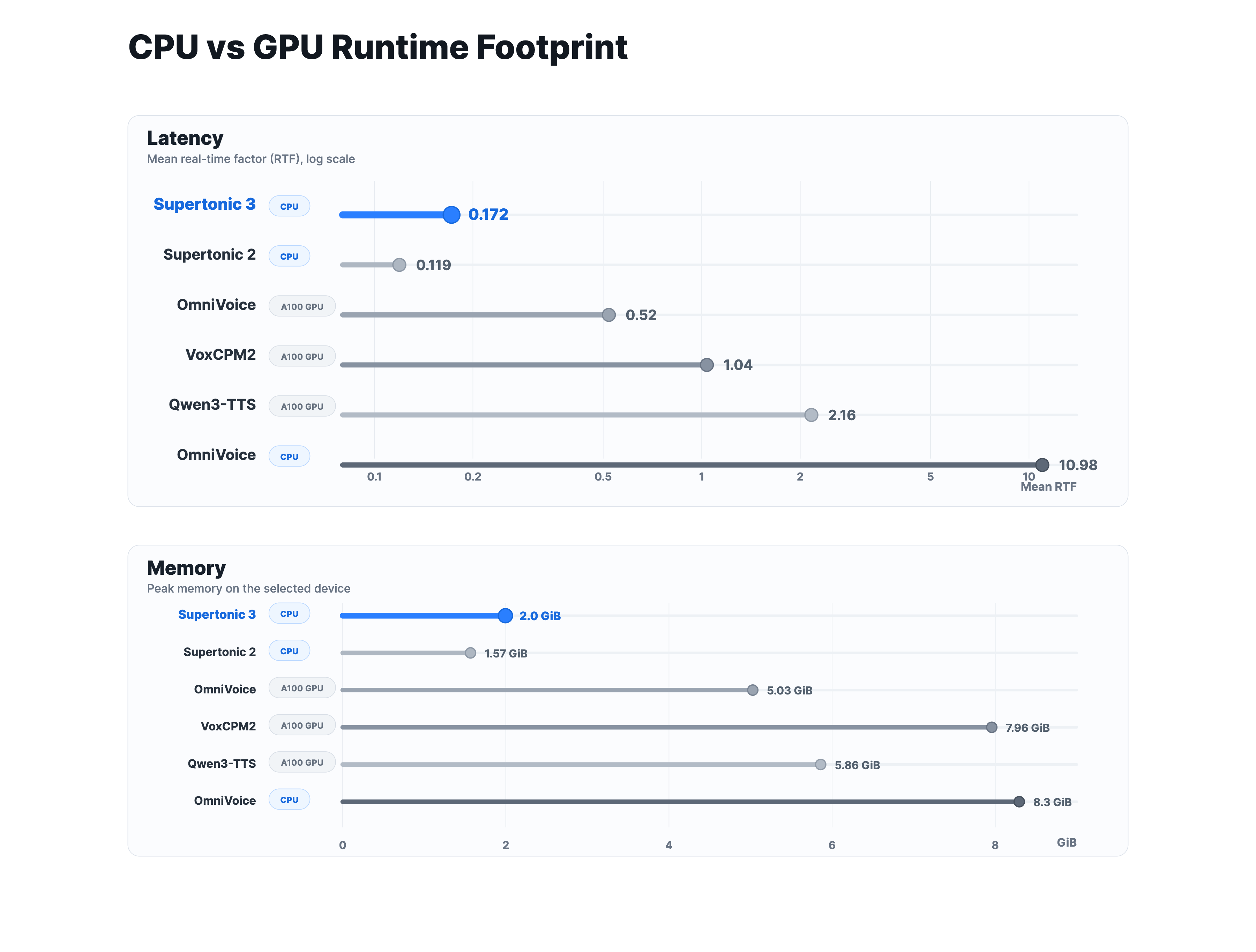
Source: Supertone’s official runtime footprint chart, reproduced unchanged.
| Supertonic 3 | |
|---|---|
| Parameters | About 99 million |
| Reading accuracy | Competitive WER/CER vs. far larger models |
| Demonstrated speed | RTF 0.3× on an e-reader; real-time on Pi |
| Output | 44.1 kHz speech |
| Languages | 31 |
| License | OpenRAIL-M |
| Role in Local TTS | The 31-language multilingual voice |
The head-to-head that explains our decision
The most direct comparison comes from an independent third-party benchmark that ran both models on the same modest 4-core CPU with no GPU—conditions closer to a phone than to an AI server. Two results matter:
- Speed: Supertonic 3 synthesized at RTF 0.313 at its standard quality setting—about 3.2× faster than real time—while Kokoro-82M measured RTF 0.469–0.509, about 2× real time. Both are faster than real time on a small CPU; Supertonic has the larger margin.
- Naturalness: the same test judged Kokoro’s English output the more human-like, with natural prosody, while Supertonic’s fastest settings sounded flatter.
In other words, an independent tester with no stake in either model reached the same conclusion the official numbers point to: Kokoro wins English naturalness, Supertonic 3 wins speed and breadth. If you were choosing one model, you would have to give something up. Local TTS chose not to choose.
Why Local TTS connects the two models
Inside Local TTS, both engines sit behind a single reader. Every voice in the voice list belongs to one of the two models, and when you pick a voice, the app routes synthesis to the right engine automatically—same play button, same highlighting, same speed controls, same offline guarantee.
English goes to Kokoro-82M
The human-preference results are the reason. When listeners consistently vote an 82M model above billion-parameter systems for English, that is the model your English audiobooks, articles, and PDFs should get. Local TTS bundles all 28 of Kokoro’s American and British English voices and runs them through a Core ML pipeline tuned for Apple silicon, which also provides the word timing that drives word-by-word highlighting—and keeps synthesizing during background playback.
Everything multilingual goes to Supertonic 3
Coverage and efficiency are the reason. One bundled Supertonic 3 model reads Korean, Japanese, German, French, Spanish, and 26 more languages at 44.1 kHz with error rates competitive with far larger systems—and its CPU-first design means background reading and long documents stay practical on a battery. Ten preset styles (F1–F5, M1–M5) each read all 31 languages, so a document that switches languages keeps one consistent voice.
What pairing them avoids
- A single English-only app. Kokoro alone would leave 30 languages without a strong voice.
- A single flatter English voice. Supertonic alone would trade away the arena-winning English naturalness and the 28-voice English catalog.
- A cloud fallback. Both models are small enough to bundle, so no text ever leaves the device to reach “the better model on a server.”
The composite design costs some app size and engineering complexity, and we consider that a good trade: the benchmarks above are, in effect, the specification for it.
Download Local TTS free on the App Store and compare both engines on your own text—three Kokoro English voices and one Supertonic 3 multilingual voice are free.
How to read these numbers honestly
Benchmarks inform a decision; they do not end the discussion. Keep four caveats in mind:
- Upstream numbers were not measured on an iPhone. Arena rankings, WER tables, and RTF figures come from their publishers’ hardware. On-device performance in Local TTS depends on your device, text, and settings; the model rankings, however, have held up across the independent CPU tests we can find.
- Arena rankings move. Kokoro’s #1 result is the official record of its v0.19 evaluation window; new models enter arenas every month. What the result durably established is that compact models can win blind English listening tests.
- WER/CER is scored by machine transcription. It measures whether words were spoken correctly, not whether delivery was beautiful—that is what the human arena measures, which is why both metrics are worth reading together.
- Speed settings trade quality. Supertonic’s very fastest configurations lower naturalness. Local TTS uses the balanced setting, not the headline-grabbing one.
Frequently asked questions
Does Local TTS really run both models on the device?
Yes. Kokoro-82M and Supertonic 3 are both bundled with the app. Text, documents, and generated audio are processed on your iPhone or iPad, with no speech server.
Which model will I actually hear?
It follows your voice choice. The 28 American and British English voices are Kokoro-82M; the ten multilingual styles (F1–F5, M1–M5) are Supertonic 3. You can switch per note at any time.
Why not just use the bigger benchmark winners like VoxCPM2 or Qwen3-TTS?
Those systems are several times larger and are benchmarked on server GPUs. Local TTS is built around models that run offline on a phone; within that constraint, these two are the strongest published combination we know of.
Is Kokoro faster or is Supertonic faster?
On the same small CPU, independent testing measured Supertonic 3 at roughly 3× real time and Kokoro at roughly 2× real time. Both are comfortably fast enough for continuous reading in Local TTS.
Do the two engines sound different?
Yes, deliberately. Kokoro voices are individual English personalities; Supertonic styles are consistent multilingual narrators. Preview a few voices on your own text—the free version includes both engines.
Does any of this require an internet connection?
No. Both models generate speech offline. Airplane mode is a fine place to test that claim.
Hear the benchmarks for yourself
Numbers explain a design; your ears confirm it. Paste an English article and listen to a Kokoro voice, then paste a Korean, German, or Spanish paragraph and hear Supertonic 3 take over—same app, same privacy, no cloud in between.
Download Local TTS free on the App Store and listen to why we run two models instead of one.
For a deeper look at each engine, read our Kokoro-82M guide and Supertonic 3 guide.
Turn any text into speech — offline
Local TTS reads PDFs, e-books, and articles aloud right on your iPhone — private, natural, and yours.
Download on the App Store